What Legal Authority Would Be Needed to Fund the Dividend
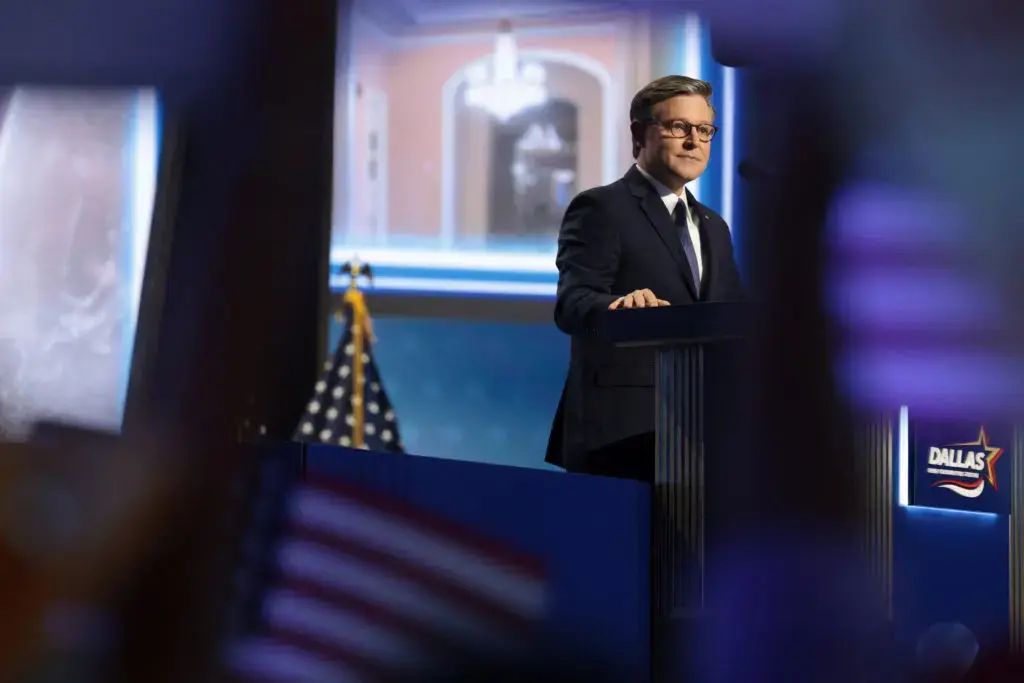
House Speaker Mike Johnson stated that former President Donald Trump’s proposal to issue a $5,000 „dividend” to American citizens must receive formal approval from Congress before implementation. Johnson made the comment following Trump’s remarks at the Republican Party’s midterm convention in Dallas last week, where the former president unveiled the idea as part of a broader economic platform. The proposal, described by Trump as a direct payment to taxpayers, has drawn attention for its unconventional nature and potential fiscal implications. Johnson emphasized that any such expenditure would require legislative authorization under the Constitution’s spending clause.
Latest news
 Swedish Voters Choose New Parliament as Left-Wing Coalition Projects to Win Majority
 Trump Announces End of US Tariff on Irish Whisky
 Frances Stonor Saunders, Author of CIA Cultural Espionage Exposé, Dies at 66
 Israel and Lebanon to Hold Security Talks in Rome This October
Trump first introduced the $5,000 dividend concept during his speech at the GOP gathering in Dallas, framing it as a way to return surplus federal funds to citizens. He suggested the money could come from reduced government spending or economic growth generated by his policies. However, no detailed funding mechanism or legislative text accompanied the announcement. Johnson, a Republican from Louisiana, acknowledged the political appeal of the idea but stressed that the power of the purse resides with Congress, not the executive branch. He noted that even if the proposal gained popularity among voters, it could not proceed without a bill passed by both the House and Senate and signed into law.
Could This Proposal Gain Traction in the Upcoming Election Cycle
To distribute $5,000 payments to approximately 160 million taxpayers, the federal government would need to allocate roughly $800 billion. Such a sum would far exceed typical discretionary spending and would likely require either new borrowing, reallocation of existing funds, or tax adjustments. Under current budget procedures, any new mandatory spending of this magnitude would trigger points of order in Congress unless offset by savings elsewhere. Johnson pointed out that Trump, as a former president, lacks unilateral authority to direct Treasury disbursements without congressional action. He also noted that the Congressional Budget Office would need to score any legislation before it could advance.
While the dividend idea has not been formally introduced as legislation, its appearance at a high-profile party event suggests it may be tested as a campaign concept. Trump’s allies have previously floated similar direct-payment ideas, including during the pandemic-era stimulus debates. However, fiscal conservatives within the GOP have often resisted large-scale direct spending without corresponding cuts. Johnson’s remarks indicate a cautious approach from House leadership, balancing responsiveness to voter sentiment with adherence to institutional norms. Whether the proposal evolves into a concrete policy initiative will depend on legislative sponsorship, public reception, and broader economic conditions ahead of the 2026 midterms.
Is the $5,000 dividend currently a bill in Congress? No, the proposal has not been introduced as legislation in either the House or Senate. It was presented as a campaign-style idea at a political convention.
Frequently Asked Questions
Who would be eligible to receive the payment under Trump’s suggestion? Trump did not specify eligibility criteria, but he framed it as a payment to taxpayers, which could imply broad distribution similar to past stimulus checks.
Does the president have the power to issue such payments without Congress? No, under the U. S. Constitution, only Congress can authorize federal expenditures. The president cannot unilaterally allocate funds for direct payments to individuals.