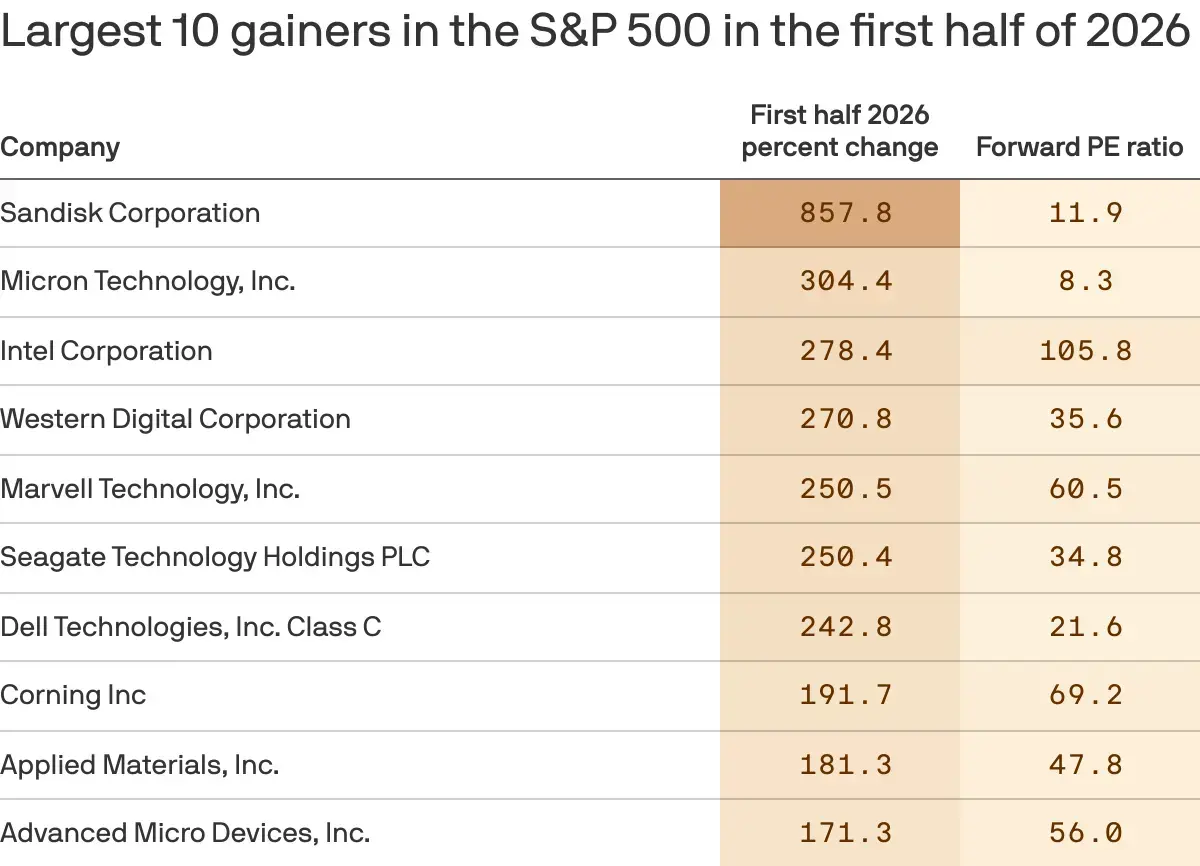
Memory Winners Look Bargain Despite Explosive Gains
The FactSet data released after the market closed on June 30, 2026 shows that the year’s top performers are memory‑related companies. Despite delivering double‑digit returns, these giants now trade at price‑to‑earnings ratios that seem unusually low for such high‑growth stocks.
Latest news
 Swedish Voters Choose New Parliament as Left-Wing Coalition Projects to Win Majority
 Trump Announces End of US Tariff on Irish Whisky
 Frances Stonor Saunders, Author of CIA Cultural Espionage Exposé, Dies at 66
 Israel and Lebanon to Hold Security Talks in Rome This October
Investors have poured capital into DRAM and NAND producers, betting on continued demand from data‑center expansion and AI workloads. The surge in earnings has been tempered by a cautious market that fears the current boom may be fleeting. Analysts point to the widening gap between revenue growth and valuation multiples as a sign that investors are pricing in a potential slowdown.
The table compiled by Matt Phillips of Axios highlights that the leading memory firms have seen earnings multiply by more than three times since the start of the year. Yet their average P/E sits near 8, well below the historical sector average of 15. „The numbers are striking,” said Laura Chen, senior analyst at Global Equity Partners. „You have companies delivering robust top‑line growth, but the market is demanding a steep discount to compensate for perceived risk.”
Are These Low Valuations a Warning Sign or an Opportunity?
The discount reflects concerns over inventory cycles and the possibility of overcapacity in semiconductor fabs. Supply‑chain analysts note that many manufacturers expanded capacity during the previous demand surge, and any dip in orders could leave excess inventory idle. Despite these worries, the underlying fundamentals remain strong, with memory demand projected to rise 12 % annually through 2028, according to industry forecasts.
Some market observers argue that the current environment mirrors past cycles where exuberant pricing corrected sharply. „We’re seeing a classic ‘buy the dip’ mentality, but the fundamentals may not support a rapid rebound if demand softens,” warned Michael Alvarez, chief economist at Meridian Research. Conversely, other experts contend that the sector’s structural tailwinds—cloud computing, edge AI, and autonomous vehicles—justify a more optimistic outlook. „If the sector can sustain its growth trajectory, these valuations could represent a rare entry point for long‑term investors,” suggested Emily Rivera, portfolio manager at Horizon Funds.
The debate hinges on whether the market’s caution is justified or overly pessimistic. If memory demand continues to outpace supply, earnings could accelerate, narrowing the valuation gap. However, a misstep in capacity planning or a slowdown in AI spending could deepen the discount, pressuring stocks further.
Looking ahead, investors will monitor quarterly earnings reports and capacity utilization rates closely. A sustained earnings beat could validate the low multiples as a buying opportunity, while missed forecasts may trigger broader market sell‑offs. In either scenario, the memory sector remains a focal point for those tracking the intersection of technology demand and valuation risk.
Frequently Asked Questions
Why are memory stocks trading at such low price‑to‑earnings multiples? Investors are factoring in the risk of a demand slowdown and potential overcapacity, which pushes valuations down despite strong earnings growth.
Can the current cheap valuations lead to higher returns? If earnings continue to rise and demand stays robust, the low multiples could translate into significant upside for shareholders.
What indicators should investors watch to gauge future performance? Key metrics include quarterly earnings beats, inventory levels, capacity utilization, and broader AI and data‑center spending trends.