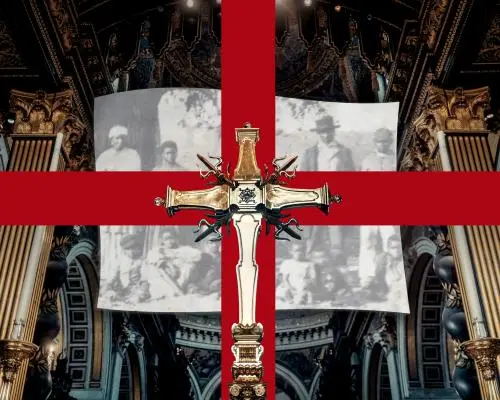
The Scope of Institutional Complicity
The debate over reparative justice within the Church of England has intensified following the discovery of historical records linking Anglican clergy to the machinery of slavery. While the Bishop was in West Africa, British researchers digitizing the Register of British Slave Traders uncovered evidence that Anglican priests directly financed the Royal African Company (RAC).
Latest news
 Saudi Arabia Declares Mecca Attack Attempt a Red Line as Houthis Deny Involvement
 Surrey Oil Drilling Project Sold After Supreme Court Rejection
 Union leaders urge bold action for Labour leader
 Wildfire Crisis Deepens as Federal Firefighter Shortage Plagues Summer Season
This organization transported more enslaved African men, women, and children than any other single entity in history. The register documents investors over a 250-year period, including 45 Anglican clerics. Their capital funded hundreds of slaving voyages and supported the RAC’s 1720 relaunch. Among these investors was Henry Brydges, later a canon at St. Paul’s Cathedral, who purchased a £10,000 stake the same day he was named Archbishop of Rochester.
Professor William Pettigrew, who led the digitalization project, noted that the register reveals a truly national scale of involvement. Profits from slavery permeated local communities from Cumbria to the Cotswolds through parish bequests. These findings reinforce a narrative that the Church of England effectively „blessed slavery,”prompting intense scrutiny regarding whether current efforts at atonement are sufficient.
In 2023, the Church Commissioners launched the Spire Project, a £100 million impact investment fund for communities affected by slavery’s legacy. While not strictly a reparations fund, it aims to foster justice and healing. This initiative has sparked internal division, arriving nearly two decades after former Archbishop Rowan Williams rejected the notion that the modern church held no responsibility for the past.
A Legacy of Exploitation
The Spire Project primarily addresses historical investments in the South Sea Company, which trafficked nearly 45,000 enslaved Africans. However, historical geographer Professor Alan Lester argues this represents only a fraction of the church's complicity. He emphasizes that plantation profits fueled the Industrial Revolution, public health, education, and the construction of churches across Britain.
For Reverend Natasha Beckles, Dean for Racial Justice in Willesden, confronting this history is a theological necessity. She questions the purpose of the cross if the church cannot address such profound injustice. Dr. Leona Vaughn, co-organizer of a 2025 truth-tellingevent, notes that the public remains largely unaware of the institution's full involvement, including the use of the Slave Bible—an edited version of scripture used to enforce social control starting in 1807.
The history of the United Society Partners in the Gospel (USPG) further illustrates this exploitation. Its predecessor, the Society for the Propagation of the Gospel (SPG), provided chaplains for the RAC at Cape Coast Castle. For over 120 years, the SPG held enslaved people on the Codrington estate in Barbados, generating the equivalent of £5 million annually in today’s currency. At Codrington, enslaved Africans were branded with the word Society,subjected to torture, and worked to death. Professor Pettigrew maintains that the church's relationship with Codrington sends a clear, harrowing signal about its past.