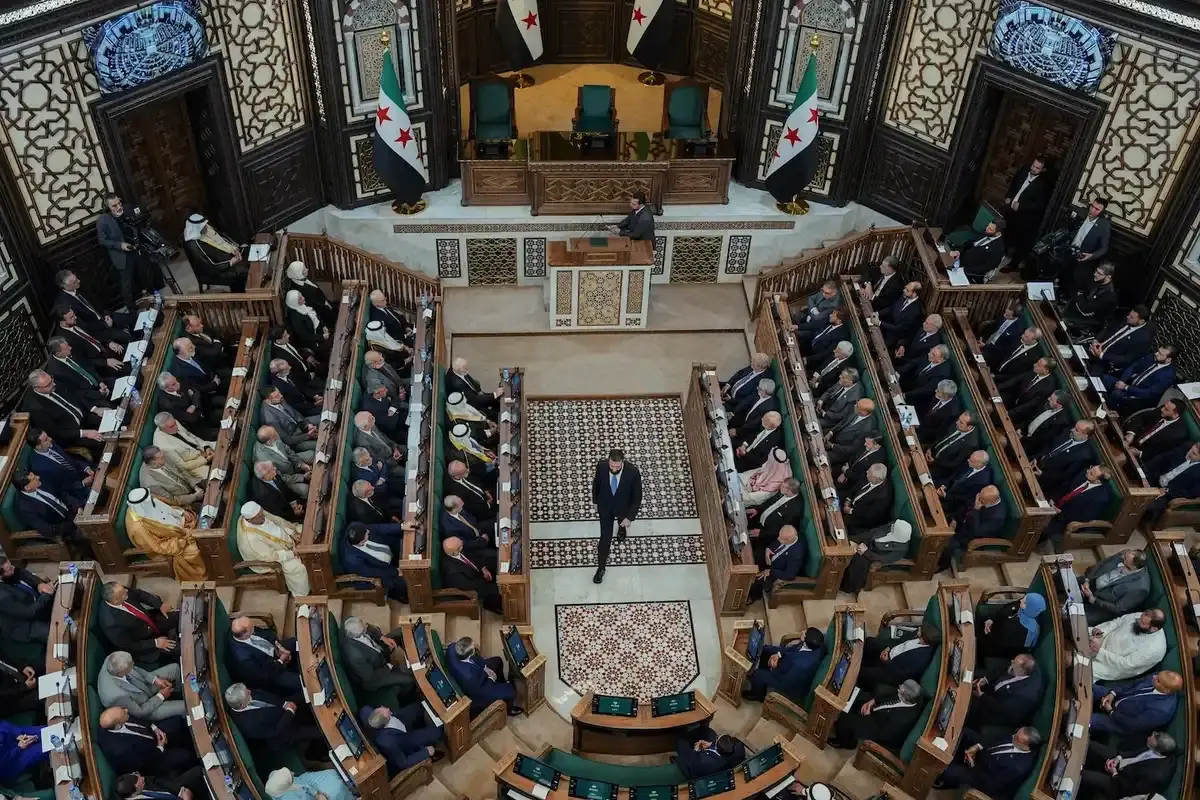
Understanding the Assembly's True Influence
Syria's newly convened parliament, though far from a democratic institution, continues to play a role in the nation's political landscape. This assembly, recently inaugurated, operates under significant constraints. Its functions are largely ceremonial, yet its existence offers a degree of insight into the country's governance.
Latest news
 Swedish Voters Choose New Parliament as Left-Wing Coalition Projects to Win Majority
 Trump Announces End of US Tariff on Irish Whisky
 Frances Stonor Saunders, Author of CIA Cultural Espionage Exposé, Dies at 66
 Israel and Lebanon to Hold Security Talks in Rome This October
The parliament's composition and operational methods reflect the centralized power structure prevalent in Syria. Elections are tightly controlled, ensuring outcomes that align with the ruling establishment. Despite these limitations, the body serves as a platform for certain discussions.
The Syrian parliament is not designed to challenge the executive branch. Instead, it primarily ratifies decisions already made by higher authorities. Members often act as conduits for local grievances, channeling them upwards through the system. This indirect influence can sometimes lead to minor policy adjustments or the addressing of specific community needs.
Can a Weak Parliament Still Effect Change?
Furthermore, the parliament provides a veneer of legitimacy for the government on the international stage. Its existence, even in a diminished capacity, allows for the pretense of a representative system. This can be crucial for diplomatic relations and international aid efforts.
While direct legislative power is minimal, the parliament can still exert a subtle influence. Debates, even if controlled, can highlight issues that might otherwise remain unaddressed. The mere act of public discussion, however restricted, can sometimes pressure the government to acknowledge certain problems.
Moreover, individual members, through their connections and local standing, can act as intermediaries between the populace and the state. This informal role can be more impactful than their official legislative duties. Their ability to voice concerns, however cautiously, offers a limited channel for public input.
Ultimately, the Syrian parliament, despite its inherent weaknesses, remains a component of the country's political system. Its continued operation, even with limited democratic function, provides a degree of stability and a controlled forum for national discourse. Its future relevance will likely continue to be tied to the broader political developments within Syria.
Frequently Asked Questions
What is the primary function of the Syrian parliament? The parliament primarily ratifies decisions made by the executive branch and provides a platform for controlled discussions. It also offers a symbolic representation of governance for international relations.
How are members of the Syrian parliament selected? Members are chosen through elections that are tightly controlled, ensuring outcomes that align with the ruling establishment. This process limits genuine democratic representation.
Can the parliament challenge government decisions? Direct challenges to government decisions are rare due to the centralized power structure. However, members can sometimes influence minor policy adjustments or address local grievances through indirect means.