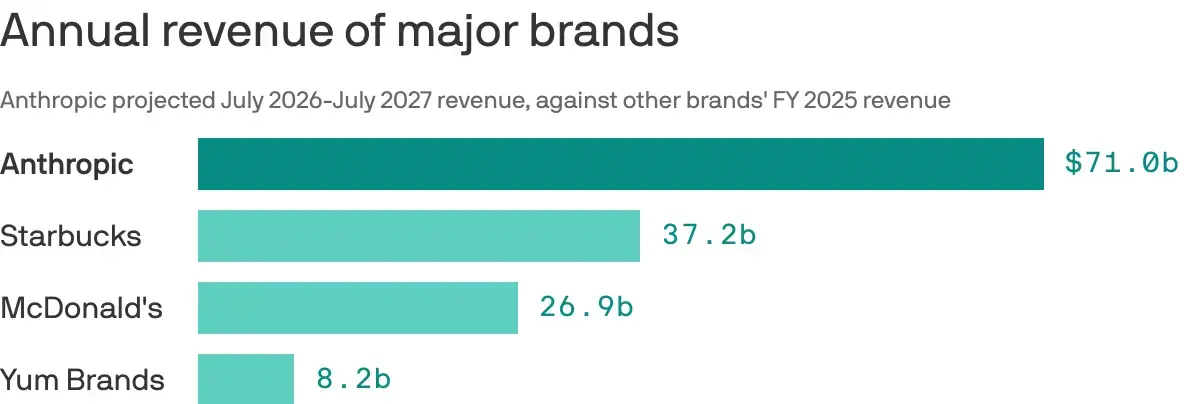
Revenue Growth Leaves Traditional Brands in the Dust
In the latest quarterly filings, Anthropic and OpenAI reported revenues that now exceed the annual sales of global icons such as Starbucks and McDonald’s. The data, compiled by financial analytics firm Funda and highlighted in a „Key Context” report, shows the AI firms’ earnings accelerating at an unprecedented pace. The trend was observed across the most recent fiscal quarter, with both companies posting figures that dwarf traditional consumer brands.
Latest news
 Swedish Voters Choose New Parliament as Left-Wing Coalition Projects to Win Majority
 Trump Announces End of US Tariff on Irish Whisky
 Frances Stonor Saunders, Author of CIA Cultural Espionage Exposé, Dies at 66
 Israel and Lebanon to Hold Security Talks in Rome This October
Analysts attribute the surge to exploding demand for generative‑AI services and massive corporate spending on AI infrastructure. Venture capital inflows and enterprise contracts have turned what was once a niche market into a trillion‑dollar opportunity. The „Key Context” chart, prepared by Ben Berkowitz of AxiosAI, illustrates the steep revenue curve, suggesting that AI providers are now major players in the global economy. Investors are beginning to see tangible returns, reinforcing confidence in the sector’s long‑term viability.
The revenue trajectories of Anthropic and OpenAI have outstripped the combined sales of Starbucks and McDonald’s for the first time. This milestone underscores how quickly AI services have moved from experimental tools to essential business platforms. Companies across finance, healthcare, and media are licensing large‑scale language models to automate content creation, customer support, and data analysis. As a result, AI firms are capturing a larger share of corporate IT budgets, which historically funded hardware, software licenses, and consulting services.
Can AI Companies Sustain Their Explosive Growth?
Industry observers note that the shift reflects a broader reallocation of capital toward cloud‑based AI compute. „The speed at which these firms are scaling is extraordinary,” said a senior analyst at a leading investment bank. „When you compare their quarterly earnings to the annual turnover of a coffee chain, the disparity is striking.” The rapid growth also pressures traditional brands to innovate or risk being eclipsed in market relevance.
Sustaining such rapid expansion raises questions about market saturation and operational limits. While current demand is robust, the sector faces challenges including talent shortages, rising energy costs for data centers, and potential regulatory scrutiny. Moreover, the competitive landscape is intensifying as tech giants launch their own AI platforms, potentially fragmenting the market.
Experts argue that continued investment in research and infrastructure will be crucial. „If Anthropic and OpenAI can maintain their pace, they will likely cement AI as a core utility, much like electricity,” explained a technology economist. However, any slowdown in corporate spending or a shift in regulatory policy could temper growth, forcing firms to diversify revenue streams beyond pure AI services.
The broader economic impact of AI’s rise is already evident. As AI providers capture larger slices of corporate spend, traditional consumer brands may need to reinvent their digital strategies to stay relevant. The next few years will determine whether the AI boom translates into lasting market dominance or a temporary surge fueled by hype.
Frequently Asked Questions
What drives the revenue surge for Anthropic and OpenAI? The surge stems from heightened enterprise adoption of generative‑AI tools, large‑scale licensing deals, and a shift in corporate IT budgets toward AI infrastructure.
Will the AI sector continue to outpace consumer brands? If demand for AI services remains strong and firms overcome operational challenges, they could maintain a growth trajectory that outstrips many traditional consumer brands.
How might regulation affect AI companies’ growth? New regulations on data privacy, model transparency, or AI safety could impose compliance costs, potentially slowing revenue expansion but also creating new market opportunities for compliant providers.