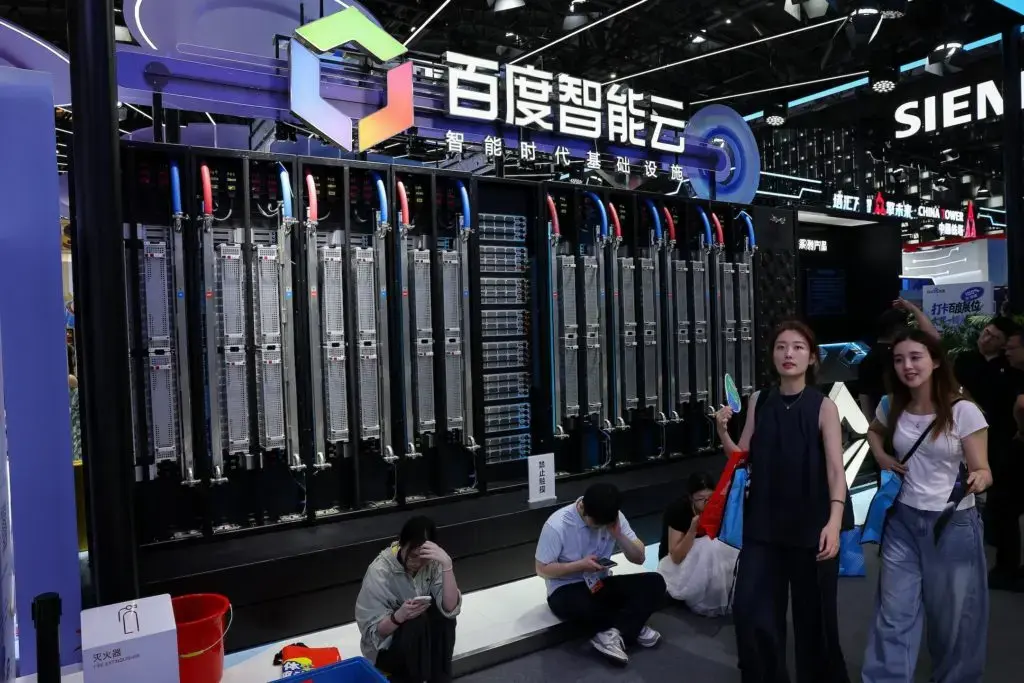
China’s AI surge reshapes global competition
Washington, July 22 — Researchers in Beijing announced new artificial‑intelligence models that outperform comparable U. S. systems in language understanding and image generation. The revelations arrived at a time when the United States is tightening export controls on advanced chips. Officials say the advances could shift the balance of power in the global tech arena.
Latest news
 Swedish Voters Choose New Parliament as Left-Wing Coalition Projects to Win Majority
 Trump Announces End of US Tariff on Irish Whisky
 Frances Stonor Saunders, Author of CIA Cultural Espionage Exposé, Dies at 66
 Israel and Lebanon to Hold Security Talks in Rome This October
The Chinese teams, backed by state‑run labs and private capital, claim their models achieve higher accuracy on benchmark tests while using fewer computational resources. Analysts point to a coordinated push that began after China’s 2025 AI plan emphasized self‑reliance. The United States, meanwhile, faces mounting pressure to safeguard its own AI talent and infrastructure. Experts warn that the gap may widen if policy responses lag behind innovation cycles.
The breakthrough models were unveiled at a conference in Shanghai, where lead scientist Li Wei highlighted a 15 percent improvement over the latest U. S. offerings on the widely used GLUE language benchmark. „We have reached a point where our systems can match, and in some cases exceed, the performance of Western counterparts,” Li said. The achievement stems from a novel training technique that reduces the need for expensive hardware, allowing faster iteration cycles.
Will the United States lose its tech edge?
U. S. officials have begun reviewing the implications for national security. The Department of Commerce is considering tighter licensing for semiconductor exports to China, aiming to curb the flow of high‑end chips that power such AI research. Meanwhile, American tech firms are accelerating their own development pipelines, hoping to retain a lead in foundational model architecture. The rivalry is intensifying, with both sides investing billions in research, talent recruitment, and strategic partnerships.
Critics argue that the United States could see its preeminence erode if it cannot match China’s pace. „The risk is not just economic; it’s strategic,” warned Dr. Elena Martinez, a senior fellow at the Brookings Institution. She noted that AI capabilities influence everything from autonomous weapons to cyber‑defense. However, she also highlighted that the U. S. retains advantages in data access, venture capital, and a robust ecosystem of startups.
Policy makers are debating whether to increase funding for domestic AI initiatives or to forge international alliances that can collectively counterbalance China’s rise. Some propose a coordinated approach with allies such as the European Union and Japan, focusing on shared standards and joint research programs. The outcome will likely hinge on how quickly the United States can adapt its regulatory framework without stifling innovation.
The coming months will test the resilience of U. S. leadership in AI. If Washington can align policy, industry, and academia, it may preserve its strategic advantage. Failure to act could see China narrowing the gap, reshaping the global technology hierarchy and altering the balance of power across multiple sectors.
Frequently Asked Questions
What specific improvements do the Chinese models claim? They report a 15 percent boost on language benchmarks and a 20 percent reduction in training time, achieved through a new efficient‑training algorithm.
How is the U. S. government responding? The administration is reviewing export controls on advanced semiconductors and considering increased funding for domestic AI research to maintain competitiveness.
Will this affect everyday technology users? Potentially. Faster AI development could lead to new consumer products, but also raises concerns about data privacy and security as capabilities expand globally.