How Chinese Clean Technology Is Redrawing Ukraine’s Energy Security in Wartime
Russia’s war against Ukraine has demonstrated that energy security no longer depends only on fuels, pipelines, or large power plants, but also on decentralized technologies such as solar panels, batteries, and other equipment that can keep the energy system functioning even during attacks. Paradoxically, much of the equipment helping Ukraine keep the lights on comes from China. Although Beijing maintains close strategic ties with Moscow, through international trade and global supply chains, clean technologies produced in China are helping reduce the vulnerability created by Russian attacks on Ukraine’s energy infrastructure.
Latest news
 US Steel Prices Surge to Four‑Year Peak Amid Trump Tariffs
 Wall Street's AI spending spree faces growing skepticism
 Geothermal Energy Gains Rare Bipartisan Support Amid AI-Driven Power Surge
 AI Sovereignty: Europe’s Bid to Catch Up with U.S. and China
Russian attacks have highlighted the fragility of Ukraine’s centralized energy system. According to the International Energy Agency, approximately half of the country’s generation capacity was destroyed, degraded, or occupied during 2022–2023, and nearly the same proportion of major grid substations suffered damage due to missile and drone strikes. In spring 2024, after a new wave of attacks, Ukraine lost another 9 GW of generation capacity, leaving it with only about one-third of its prewar capacity. On January 20, 2026, a major Russian attack on Ukraine’s energy infrastructure left nearly half of Kyiv without heat and electricity. These events have transformed large, fixed energy assets into essential points of vulnerability, giving decentralized energy an increasingly important role as a source of resilience.
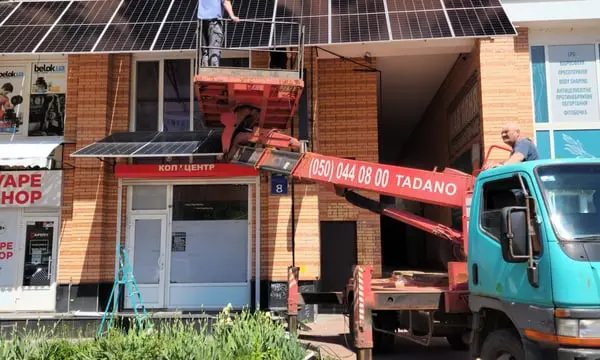
Against this backdrop, Ukraine’s solar energy market has begun to recover. Before Russia’s full-scale invasion, Ukraine was already a significant player in this market, ranking ninth globally in new solar capacity additions in 2019. However, deployment and trade activity collapsed after February 2022. Chinese solar module exports to Ukraine dropped from 83.9 MW in February 2022 to just 7.5 MW in March, and the annual total for 2023 was 15.8 MW. Nevertheless, the economy has started to recover gradually. The Ukrainian Solar Energy Association estimates that approximately 800 MW of solar power were installed in 2024 and 1.5 GW in 2025. Companies and households have begun investing in solar panels to reduce dependence on the national grid. Thus, distributed solar energy, often paired with battery storage systems, has become an essential component of energy security during the war.
International organizations such as the International Energy Agency and the Center for Strategic and International Studies have recently analyzed Ukraine’s energy reconstruction, taking into account factors such as decentralization, solar power generation, battery storage, financing, and electricity market reform. However, these reports provide very little information about the origin of the equipment needed for this transformation. In particular, the contribution of Chinese-made equipment has received little attention. According to the International Energy Agency, China holds approximately 85% of global manufacturing capacity for the solar supply chain and about 80% for lithium-ion batteries. In some segments, the share is even higher—for example, China accounts for approximately 95% of global photovoltaic wafer capacity. Currently, there is no authoritative estimate of the specific share of Chinese equipment in Ukraine’s solar and battery markets, partially because some products reach Ukraine via third countries, international procurement channels, and aid programs.
Nevertheless, given China’s dominance over these supply chains, it is highly likely that Chinese-made equipment plays an important role in Ukraine’s decentralized energy expansion and will continue to do so.
This raises an interesting question: In a tense geopolitical context, does China’s dominance over these technologies give it a certain influence? Could Beijing use access to clean technologies as a tool of political pressure? Undoubtedly, supply chain concentration creates a certain structural influence. However, as we argued in an article published in September 2025 in The Diplomat , this does not automatically translate into coercive power, as was traditionally the case with oil and gas. In Ukraine’s case, three factors are particularly relevant.
First, clean energy equipment transits through complex international trade networks. A significant amount of Chinese products can reach Ukraine indirectly, through other countries, distributors, international procurement, and support programs. This makes it difficult for Beijing to control the final destination or end-user of these equipments. Restricting these flows would require much broader measures and would be challenging from a commercial and political standpoint. Second, restrictions on clean energy would impose significant costs on Chinese industry. These could expose Chinese companies to growing regulatory and compliance risks, while strengthening Western arguments in favor of supply chain diversification, domestic production, and the concept of „friend-shoring.” In the long term, this could accelerate exactly the reduction of dependence that Chinese producers wish to avoid. Third, such restrictions would contradict China’s stated position on the Russia-Ukraine war. Beijing has repeatedly called for the promotion of peace dialogue,