Salt‑Rock Barriers Tested for Millennial Isolation
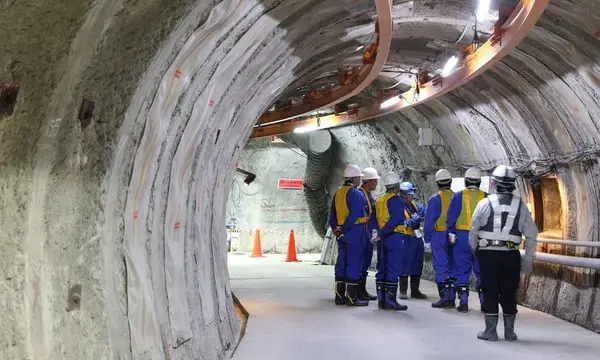
A small group of journalists entered the Horonobe Underground Research Laboratory on August 13, 2026. The facility, located on Hokkaido’s coast, houses Japanese scientists testing deep‑rock methods for storing high‑level radioactive waste. The visit was unusual, offering a rare glimpse into a project that could shape worldwide disposal strategies.
Latest news
 Swedish Voters Choose New Parliament as Left-Wing Coalition Projects to Win Majority
 Trump Announces End of US Tariff on Irish Whisky
 Frances Stonor Saunders, Author of CIA Cultural Espionage Exposé, Dies at 66
 Israel and Lebanon to Hold Security Talks in Rome This October
Japan faces mounting pressure to find permanent homes for spent fuel from its reactors. Surface storage sites are nearing capacity, and public opposition to new facilities is strong. The Horonobe lab was built to evaluate whether thick layers of salt rock can safely contain waste for millennia. Researchers drill boreholes, insert mock waste canisters, and monitor temperature, pressure, and chemical interactions over years. Their goal is to prove that geological stability can prevent leaks and protect surrounding ecosystems.
Inside the cavern, engineers have installed dozens of dummy canisters mimicking the heat output of real spent fuel. Sensors record how the surrounding salt deforms and self‑heals under stress. Lead researcher Dr. Hiroshi Tanaka noted, „The salt’s plasticity allows it to close micro‑cracks, a key advantage over harder rock types.” Early results show temperature spikes remaining within safe limits, and no measurable migration of radionuclides after two years of operation. The lab’s data are being shared with international partners, including France and Canada, who are also exploring deep‑geological options.
Can Japan’s Model Solve the World’s Nuclear Waste Crisis?
The Horonobe experiment raises the question of whether a single country’s approach can be scaled globally. Critics argue that geological conditions differ dramatically across regions, and what works in Hokkaido’s salt formations may not apply elsewhere. Proponents counter that the core principle—using natural barriers to isolate waste—remains universal. If the Japanese team can demonstrate long‑term containment, it could inspire new repositories in countries lacking suitable surface sites. The project also highlights the need for transparent monitoring, a factor that could rebuild public trust in nuclear energy.
Successful validation at Horonobe could relieve Japan’s domestic storage bottleneck and provide a template for nations wrestling with aging waste pools. International bodies are watching closely, hoping the findings will inform the next generation of deep‑geological repositories. Yet the path ahead requires sustained funding, rigorous peer review, and clear communication with communities living near potential sites. The coming decade will determine whether underground labs become the cornerstone of a global solution or remain experimental curiosities.
Frequently Asked Questions
What type of rock is used at Horonobe? The laboratory exploits thick layers of evaporite salt, which can flow slowly to seal fractures and limit radionuclide movement.
How long will the test run? Researchers plan to monitor the mock canisters for at least 100 years, gathering data on long‑term thermal and mechanical behavior.
Is the Horonobe approach being considered elsewhere? Several countries, including Sweden and the United Arab Emirates, have expressed interest in adapting the salt‑rock methodology for their own waste disposal programs.