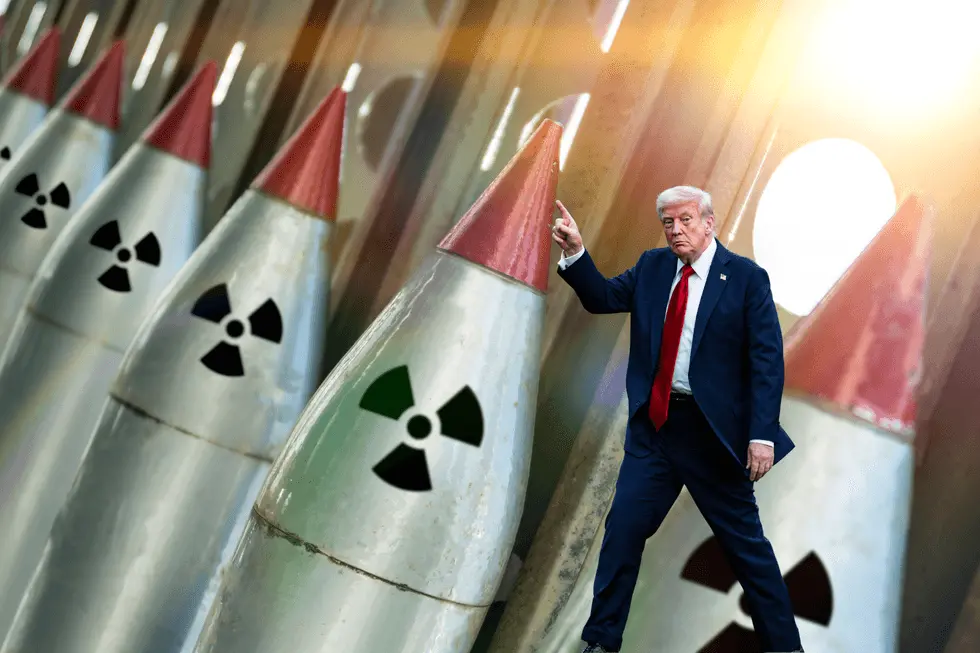
The Nuclear Dilemma
For decades, the United States viewed the prospect of an Iranian nuclear weapon as a dire threat. However, when Washington and Tehran went to war twice in a span of roughly a year, America's own nuclear arsenal failed to provide significant leverage.
Latest news
 Swedish Voters Choose New Parliament as Left-Wing Coalition Projects to Win Majority
 Trump Announces End of US Tariff on Irish Whisky
 Frances Stonor Saunders, Author of CIA Cultural Espionage Exposé, Dies at 66
 Israel and Lebanon to Hold Security Talks in Rome This October
The June 2025 US-Israeli attack on Iran's nuclear facilities was a striking example of this limited influence. Iran retaliated, yet the US nuclear arsenal did not appear to alter the course of the conflict. The lack of decisive action raises questions about the true value of nuclear deterrence in modern geopolitics.
The US nuclear arsenal, once seen as a cornerstone of national security, has been called upon to address the Iranian nuclear threat. However, the June 2025 attack on Iran's nuclear facilities suggests that the US nuclear arsenal may not be the game-changer it was once thought to be. The attack, which was carried out in conjunction with Israel, failed to prevent Iran from retaliating.
Can Nuclear Deterrence Work in the Middle East?
According to reports, the US nuclear arsenal was not used to deter Iran's retaliation. Instead, the US and Israel relied on conventional military action to respond to Iran's counterattacks. This approach raises questions about the effectiveness of nuclear deterrence in modern conflicts.
The June 2025 conflict between the US, Israel, and Iran has left many wondering whether nuclear deterrence is still an effective tool in the Middle East. The answer is far from clear. While nuclear deterrence has been successful in preventing major conflicts in the past, its effectiveness in the Middle East is uncertain.
Consequences and Outlook
The region's complex web of alliances and rivalries, combined with the presence of multiple nuclear-armed states, makes it difficult to predict the outcome of a nuclear conflict. Furthermore, the June 2025 conflict has highlighted the limitations of nuclear deterrence in modern geopolitics.
The limited leverage provided by the US nuclear arsenal has significant consequences for US foreign policy in the Middle East. The June 2025 conflict has highlighted the need for a more nuanced approach to nuclear deterrence in the region. The US must re-examine its nuclear strategy and consider alternative approaches to addressing the Iranian nuclear threat.
Frequently Asked Questions