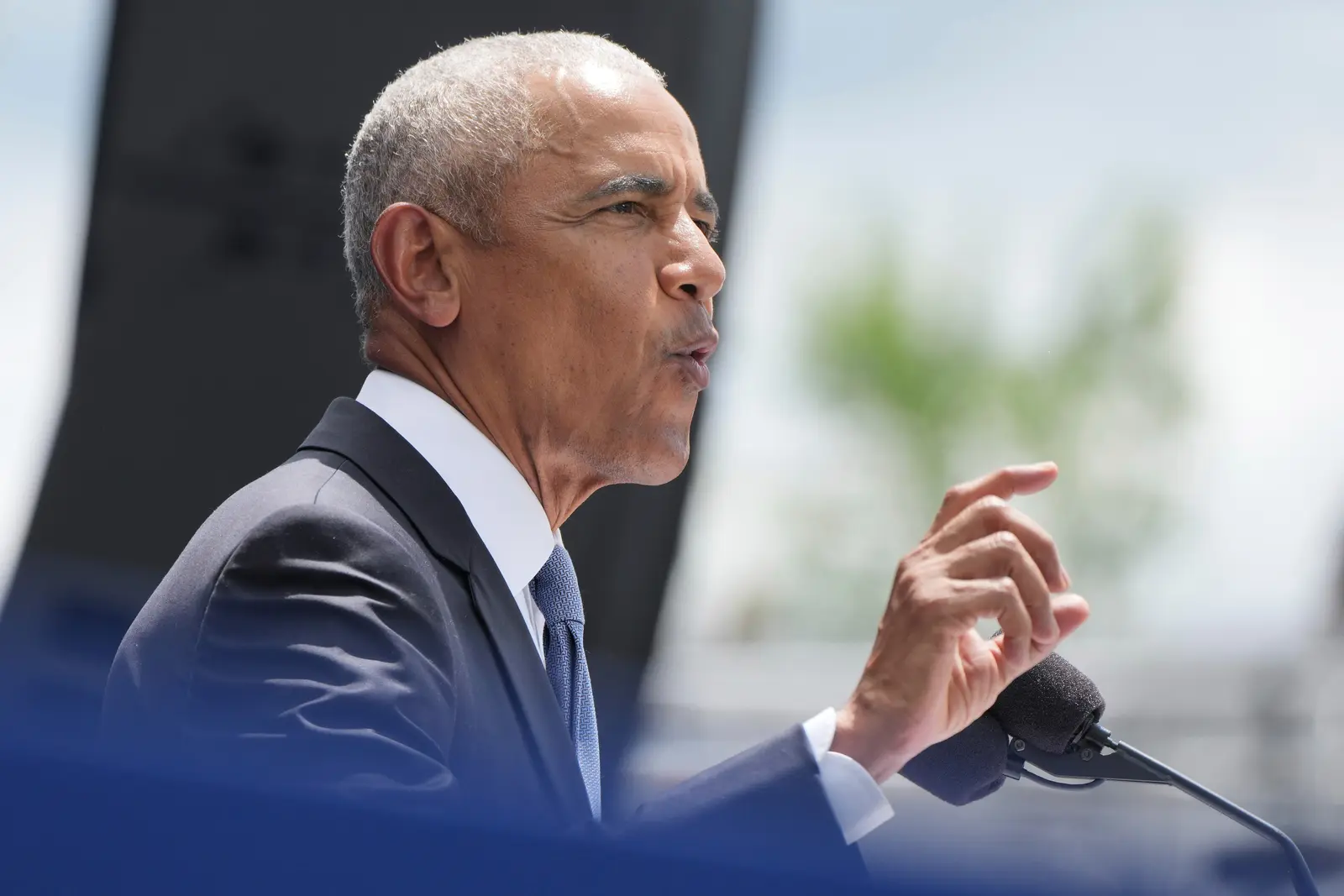
Why Obama Believes AI Requires Immediate Political Attention
Former President Barack Obama called on Democratic leaders and potential 2028 presidential candidates to develop a comprehensive artificial intelligence agenda during a private fundraiser, emphasizing the technology's rapid advancement and its implications for national policy. Speaking at the closed-door event, Obama warned that AI is reaching a critical inflection point where delayed action could leave the United States vulnerable to risks posed by unregulated private-sector innovation. He stressed that Congress and future administrations must act decisively to shape AI development in ways that align with public interest, national security, and democratic values.
Latest news
 Swedish Voters Choose New Parliament as Left-Wing Coalition Projects to Win Majority
 Trump Announces End of US Tariff on Irish Whisky
 Frances Stonor Saunders, Author of CIA Cultural Espionage Exposé, Dies at 66
 Israel and Lebanon to Hold Security Talks in Rome This October
The former president highlighted that while AI holds transformative potential across healthcare, climate modeling, and economic productivity, its current trajectory is largely driven by corporate interests without sufficient oversight. Obama argued that Democrats must move beyond reactive measures and instead establish a proactive framework that includes investment in research, ethical guidelines, workforce retraining, and international cooperation. He noted that waiting for crises to emerge before responding would be a strategic mistake, especially as other nations advance their own AI initiatives.
How Should Democrats Balance Innovation with Accountability in AI Policy?
Obama pointed to the speed of AI development in private labs as a key concern, noting that breakthroughs are occurring faster than regulatory bodies can assess their impact. He cited examples such as generative AI’s influence on elections, job displacement fears, and the concentration of power among a few tech firms as evidence that policy lags behind innovation. According to attendees, he urged Democrats to treat AI not as a technical issue but as a central challenge for governance, comparable to climate change or economic inequality in its societal reach. The former president also suggested that a strong Democratic AI platform could differentiate the party in upcoming elections by showing readiness to lead on emerging technologies.
Obama did not prescribe specific legislation but emphasized the need for principles that ensure AI serves broad public goals rather than narrow corporate or military advantages. He advocated for transparency in algorithmic decision-making, protections against bias in automated systems, and public funding for AI research that prioritizes social good. When asked about balancing innovation with regulation, he reportedly responded that the goal is not to slow progress but to steer it — comparing the moment to the early days of the internet, when early choices shaped decades of outcomes. He warned that ceding AI governance entirely to industry could undermine trust in institutions and exacerbate inequality.
What did Obama mean by calling AI an „inflection point”? He meant that AI development has reached a stage where current decisions about regulation, investment, and ethics will have long-lasting consequences, and delays in action could result in irreversible societal or geopolitical shifts.
Frequently Asked Questions
Why is Obama focusing on Democrats specifically for AI leadership? As a former Democratic president, he views the party as best positioned to advance an AI agenda centered on equity, accountability, and public investment, especially as it prepares for future elections and congressional leadership.
What risks did Obama associate with leaving AI development to private hands? He warned that without public oversight, AI could deepen economic disparities, threaten democratic processes through misinformation, and concentrate power in unaccountable corporations, ultimately eroding public trust.