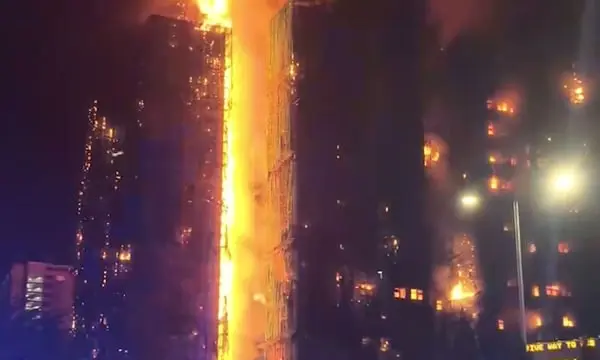
The Fire and Initial Response
Eleven months ago, in November 2025, a devastating fire struck the Wang Fuk Court block in Hong Kong. The disaster claimed 168 lives. Since then, authorities have initiated several measures. These include official apologies, the resignation of one minister, and investigations into dozens of officials. However, the power to determine who bears political responsibility remains firmly in the government’s hands. While ministers take credit for administrative successes, responsibility for failures falls on their subordinates. Bereaved families criticize this dynamic as a precisely calculated political accounting.
Latest news
 Two Trump-era projects face legal challenges in D.C. courts
 Judge Opens Probe Into Trump Lawyers Over Golf Course Dispute
 Polish Police Deployed to Top Court After Head Judge Suspended
 Oil Tanker Struck by Unknown Projectile in Strait of Hormuz
Commission Findings
The independent commission’s report was clear in its findings. Residents of the block had filed „numerous complaints and inquiries regarding fire safety at Wang Fuk Court.” Government departments ignored these warnings. They failed to exercise „real oversight.” They also allowed dangerous construction practices to continue. This included the „widespread use of foam panels to cover all windows.” The report identified serious regulatory failures involving the Housing Bureau, Buildings Department, Fire Services Department, and Labour Department.
Why Only Ho Resigned
In explaining Ho’s resignation, Lee referenced the Housing Bureau’s oversight of the Independent Checking Unit. He emphasized that she committed no personal misconduct. He described her departure as his political decision. He considered departmental responsibilities and other factors. Yet, he offered no clear criticism explaining why failures in the Housing Bureau required her minister’s resignation. Failures involving other departments did not produce equivalent consequences.
Other Ministers Stay
Development Minister Bernadette Linn, whose office oversees the Buildings Department, acknowledged considering resignation. She compared the Chief Executive to a ship’s captain. As a member of his „crew,” she was obligated to follow his instructions. Labour and Social Welfare Secretary Chris Sun similarly emphasized that politically appointed officials must answer to the Chief Executive. He stressed maintaining team spirit and broader administrative interests. He remained in office as instructed.
Executive Discretion
In other words, Ho left because Lee decided she must assume political responsibility. Other ministers stayed because Lee instructed them to continue their work. In both cases, the Chief Executive determined the outcome. The public was left to accept or criticize his judgment. Without coherent public standards, a ministerial resignation becomes a political concession granted at the Chief Executive’s discretion.
The independent commission itself was appointed by Lee. It reported its findings to him. Despite extensive public hearings and detailed findings, it remained a non-statutory body. It lacked compulsory powers to gather evidence. Its recommendations were returned to the same executive authority responsible for implementing them. That authority also determines political consequences for officials.
Limited Electoral Leverage
This concentration of discretion is consistent with Hong Kong’s political structure. The Chief Executive is selected by a 1,500-member Election Committee. He is not elected by universal suffrage. Only 20 of the 90 Legislative Council seats are directly elected. Candidates face political screening for eligibility. Citizens thus have limited electoral means to impose political consequences if they disapprove of how an administration handled a disaster.
Public Pressure Constraints
Public pressure is limited in other ways too. Shortly after the fire, student Miles Kwan was arrested by police. He had distributed materials calling for an independent inquiry and government accountability. His arrest illustrated the risks surrounding collective mobilization around the disaster. Without significant electoral leverage and with constraints on public organization, citizens have few effective means to challenge the political settlement announced by the administration.
Beijing’s Response
In this context, the Beijing Liaison Office’s response is revealing. After the commission’s report was published, the office praised Lee’s leadership. It described the government’s apologies, investigations, and reforms as evidence of „a responsible government willing to take ownership and engage in reform.” It lauded the administration’s „firm resolve” to correct old and deeply rooted problems. It encouraged Hong Kong society to „unite and look to the future” under Lee’s leadership. The statement explicitly linked the response to Hong Kong’s first five-year plan. It also tied it to the broader goal of advancing the city’s „high-quality development.”
Looking Forward
Within the Liaison Office’s framework, a report exposing widespread failures in government oversight became an occasion to celebrate the administration’s self-correction capacity. The announced measures were presented as evidence of responsible leadership. The public was encouraged to recognize the government’s efforts. Attention was directed toward future development.
Displaced Owners
The emphasis on moving forward was already visible in how the government handled displaced owners. Days before the independent commission finalized its investigation, the administration introduced a scheme to acquire property titles at Wang Fuk Court. Owners were given until August 31 to accept the offer. Most had to sign sale agreements by October 15. Both deadlines preceded the commission’s findings publication on October 29. The scheme offered urgent financial and housing arrangements for families displaced by the fire.