A Personal Catalyst
The „Songsinitiative is fundamentally transforming Port Talbot's cultural landscape. It goes beyond simple preservation to actively reshape local identity. At the heart of this effort is a personal story that sparked change. Liz Puleston-Jones had a complex relationship with Welsh musical heritage. She knew its richness but felt it was disconnected from her reality in Swansea. This changed when she investigated local history for the ”Cân y Cymoeddproject.
Latest news
 Space Security Landscape Deteriorates Rapidly Amid New US Deployments
 Wife of US Scholar Detained in China Urges Trump to Address Case During Summit
 Palestinian Man Dies in Israeli Custody After Year of Administrative Detention
 Sweden's Centre-Left Coalition Wins Election as Right-Wing Bloc Narrowly Defeated
During her research, she discovered the remarkable fate of Isabel Thomas. In the 1940s, Thomas was only fourteen years old. She left school early to support her family. To get a job in a thin steel factory, she lied about her age. „Her story spoke directly to my soul,”Puleston-Jones said. Before this experience, the link between history and folk music was foreign to her. She realized ordinary people can become part of a song. Anyone can create or share a new melody.
Community Collaboration and New Music
Today, Thomas's story is honored through a musical composition. Trac Cymru, the national Welsh folk arts organization, organizes this program. In community and school workshops, musicians, historians, and volunteers worked together. They helped groups uncover hidden stories in local heritage sites and museums. This collaboration resulted in twenty-four new songs. These tracks were inspired by life in Rhondda Cynon Taf and Neath Port Talbot. Many participants felt their cultural pride and sense of belonging reignite.
Jenny Pope, a participant in Port Talbot, described the profound impact. She noted that the area became a true beacon of folk music. A place many drove past without noticing now feels full of life and culture. Creating something to pass on to future generations was extraordinary for her. Puleston-Jones added that she initially feared writing or producing alone. However, the process proved highly collaborative. Now, instead of watching mediocre TV or scrolling social media, she is drawn to composing and playing violin. This activity makes her feel much more balanced after years away.
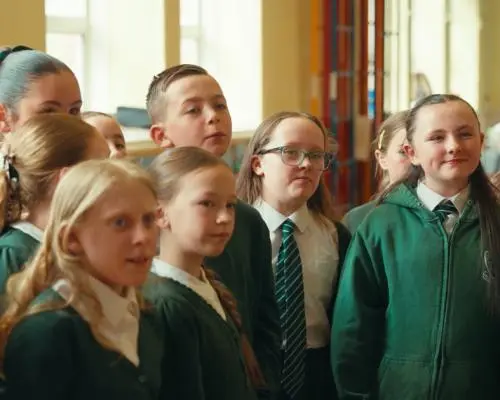
At Llwyncelyn Primary School in Porth, within the Rhondda Valley, a Year Six class is actively engaged. Students are learning a song about their village. The previous cohort composed it with fiddler Aneirin Jones. Later, the children will film a music video at Rhondda Heritage Park. This site was once a coal mine. Their track, called „Ein Cân Fach Ni”(„Our Little Song”), references local mountains, mines, and chapels. It also mentions daily activities like the recycling center and playground.
Schools and Future Generations
Ten-year-old Ifan expressed his enthusiasm. He admitted he knew the Rhondda Valley but nothing about folk music before this project. He found the experience very fun. He amusingly noted that his sister is upset. Her class wrote the song, while his class will make the video.
Original melodies are being professionally recorded for an album. Trac Cymru hopes to reach a wide audience. They aim to turn this into a resource for future generations. Project manager Antwn Owen-Hicks emphasized the importance of evolving traditions. He stated that magic happens when people explore these aspects. They begin to view their origins through a different lens. Musical level or language does not matter. If you have a story to tell, you can compose a song. The project team helps you do it.