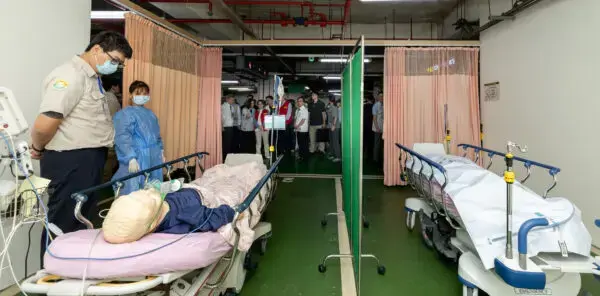
Urban Defense in Practice
Taiwan’s annual Han Kuang drills kicked off this week, drawing thousands of troops, aircraft, and naval vessels to simulate a large‑scale invasion. Vice President Hsiao Bi‑khim toured an underground command center, underscoring the government’s focus on protecting cities and civilians. The exercises run through the end of the month, testing both military firepower and civil‑defence coordination.
Latest news
 Swedish Voters Choose New Parliament as Left-Wing Coalition Projects to Win Majority
 Trump Announces End of US Tariff on Irish Whisky
 Frances Stonor Saunders, Author of CIA Cultural Espionage Exposé, Dies at 66
 Israel and Lebanon to Hold Security Talks in Rome This October
The drills mark a shift from pure combat training toward comprehensive urban resilience. Planners integrated emergency‑response teams, medical units, and infrastructure experts to mimic the chaos of a real attack on densely populated areas. Analysts say this broader approach reflects Taiwan’s need to demonstrate credible deterrence while preparing for the humanitarian fallout of any conflict. The inclusion of cyber‑defence modules, power‑grid simulations, and rapid‑repair teams signals a recognition that modern warfare extends beyond kinetic strikes.
During the opening phase, ground forces practiced securing key bridges, subway tunnels, and high‑rise districts. Soldiers rehearsed evacuations, while engineers tested portable generators and water‑purification kits under simulated blackout conditions. „Our goal is to keep the city alive even if the battle reaches its streets,” said Colonel Liu Cheng, a senior officer overseeing the urban scenario. Observers noted the tight coordination between the army and local fire departments, a partnership rarely displayed in previous drills.
Can the Drills Translate to Real‑World Resilience?
The exercises also highlighted Taiwan’s reliance on reserve forces. Over 150,000 reservists were mobilised, receiving rapid refresher training on urban combat tactics. Their participation aims to demonstrate depth of manpower, a factor that could deter potential aggressors. Data released by the Ministry of Defense showed a 30 % increase in reserve readiness compared with last year’s exercise, reflecting intensified recruitment and training efforts.
Critics argue that simulated drills may not capture the full complexity of an actual invasion. „Training is essential, but we must ask whether our infrastructure can truly withstand sustained attacks,” noted Dr. Mei‑Han Tsai, a security analyst at the Taiwan Institute of Strategic Studies. She points to the island’s aging power grid and limited underground shelter capacity as vulnerabilities that drills alone cannot fix.
The government counters that the drills are designed to expose such gaps. After each scenario, after‑action reports identify shortcomings, prompting immediate upgrades to communication networks and emergency supply chains. Recent investments include reinforced subway tunnels and mobile command units that can operate even if central headquarters are compromised.
Looking ahead, Taiwan plans to expand the scope of Han Kuang to include multinational observers, hoping to showcase its defensive resolve on the global stage. Success will depend on translating rehearsal outcomes into tangible improvements for civilians. If the island can prove that its cities remain functional under fire, the deterrence value of the drills will grow substantially.
Frequently Asked Questions
What is the primary purpose of Taiwan’s Han Kuang drills? The exercises aim to test military readiness, integrate civil‑defence capabilities, and demonstrate the island’s ability to protect urban populations during a conflict.
How do the drills enhance Taiwan’s deterrence posture? By showcasing coordinated response plans, reserve mobilization, and infrastructure resilience, the drills signal to potential aggressors that an invasion would face stiff, multi‑layered resistance.
What challenges remain despite the expanded drills? Key obstacles include aging utilities, limited underground shelters, and the difficulty of replicating the full scale of a real attack, all of which require ongoing investment and policy focus.